Snake Eyes Isn’t Overrated — He’s the Reason G.I. Joe Still Lives in Pop Culture (1982–2026)

Every few months, the same hot take pops up in the niche corners of the online G.I. Joe scene: “Snake Eyes is overrated.” And every time I hear it, I think the same thing… Snake Eyes isn’t overrated — Snake Eyes is the bridge. He’s the character that non-hardcore fans remember instantly. The one casual audiences recognize even if they can’t name 20 Joes, recite filecards, or debate the best era of the comics. If you grew up in the 80s, you didn’t need a deep dive to understand him. He looked cool. He moved cool. He felt dangerous. And in a toy line filled with loud personalities, bright colors, and big “YO JOE!” energy, Snake Eyes was the silent storm.
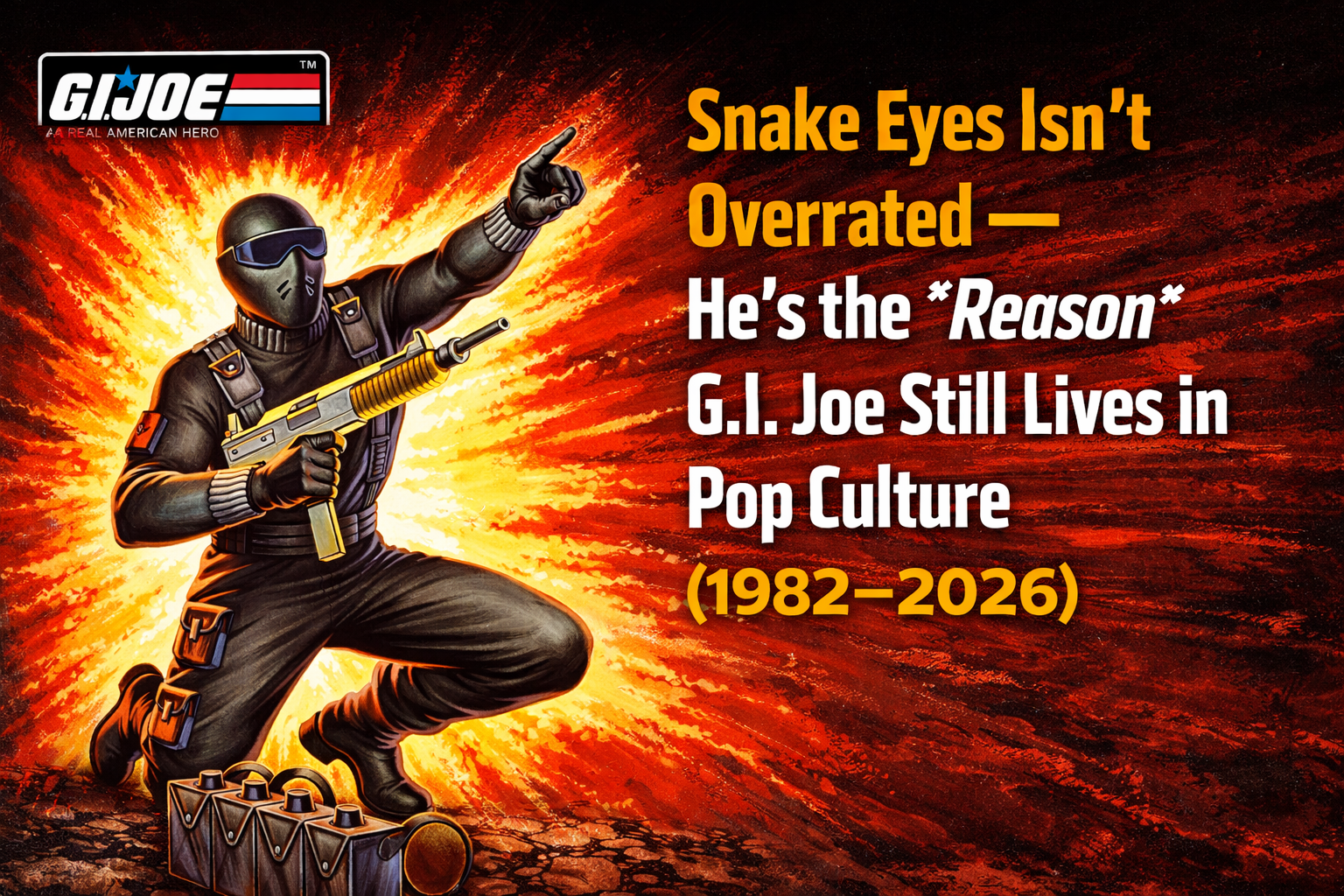
Snake Eyes hit like lightning right out of the gate in 1982 as one of the original figures, and he immediately stood apart. A black-clad commando with a faceless visor, he looked like he stepped out of a classified mission briefing instead of a toy aisle. Even as kids, we understood the visual language: this guy wasn’t here to talk, he was here to win. That design alone helped make him the instant icon of the brand, the one figure you didn’t have to explain to a friend who wasn’t fully locked into the line.
But what elevated Snake Eyes beyond “cool toy” status was story, and that’s where Larry Hama’s influence becomes undeniable. Hama didn’t turn him into a gimmick — he made him a legend. Snake Eyes wasn’t defined by catchphrases or comedy relief moments. His identity formed through loyalty, sacrifice, discipline, restraint, and a deep sense of duty. He’s the embodiment of doing what needs to be done without demanding attention for it. That’s why Snake Eyes connects with fans across generations: the character’s values are timeless, and his silence only makes those values louder.
If you want the ultimate proof that Snake Eyes is not overrated, look no further than one of the most famous issues in G.I. Joe history: the “Silent Interlude” comic. No dialogue. No narration. No shortcuts. Just pure visual storytelling with Snake Eyes driving the entire experience through action, body language, and intensity. That’s not hype — that’s craftsmanship. It’s also one of the moments that cemented Snake Eyes as more than a popular figure; it proved he could carry storytelling in a way very few characters in comics ever could.
Then came the Timber era, and Snake Eyes gained something even more powerful than mystery: heart. Timber wasn’t just “a cool wolf accessory.” Timber gave the audience a glimpse into Snake Eyes’ humanity. A character who rarely speaks needs emotion expressed through the world around him, and the bond between Snake Eyes and Timber became one of the most memorable relationships in the entire franchise. It told you everything you needed to know: behind the mask was someone with loyalty and compassion, someone who fought hard but cared even harder.
Now let’s address the “oversaturated” argument, because this is where the niche online debate starts to fall apart. Icons are supposed to be everywhere. Nobody claims Superman is overrated because he’s the face of DC. Nobody claims Spider-Man is oversaturated because he has a million suits, cartoons, and films. Nobody says Wolverine should be “used less” because he constantly gets spotlight stories. Nobody says Batman is too popular because he sells more merch than half his universe combined. They aren’t called overrated — they’re called pillars. They are characters who carry brands, bring new audiences in, and keep the franchise alive when the spotlight shifts.
Snake Eyes is that pillar for G.I. Joe. He’s the face that sells the idea of G.I. Joe to people who aren’t in the hardcore collector trenches. He’s the gateway character. The one that makes a casual fan stop scrolling. The one that makes someone say, “Oh man… I remember G.I. Joe.” That kind of recognition is priceless, and it’s the opposite of a problem.
Even when Hollywood tried to reshape the franchise for modern audiences, Snake Eyes stayed at the center because he’s the character the mainstream knows. Live-action appearances kept him in the conversation, and newer comics and storylines continued to evolve him without losing what makes him Snake Eyes. From 1982 through 2026, the character has proven he can move from toy shelves to comics to cartoons to movies to new publishing eras and still feel essential. That doesn’t happen by accident. That happens because the character’s core is solid.
So when a small pocket of fandom throws out the “overrated” label, what they’re really reacting to is that Snake Eyes is bigger than the niche. He’s bigger than arguments over screen time, figure counts, and who “deserves” a slot in the lineup. Snake Eyes has always been larger than the bubble — and that’s why he works. He doesn’t steal attention from G.I. Joe. He shines a spotlight on G.I. Joe. And for most fans — especially the ones who aren’t spending hours in online debates — Snake Eyes isn’t the problem. He’s the reason the brand is still loved in the first place.
When the world thinks G.I. Joe… they think Snake Eyes.